

Risk Management · 2025
In this section3 topics
Risk Management Policy & Plan
Policy & Plan Description
The Company has established a risk management policy by setting up a risk management committee to be responsible for developing policies, implementing systems, and evaluating various risks that may arise from external factors and from internal management and operations. The policy also sets guidelines for managing and controlling risks at an acceptable level, including communication, training, and practical seminars for employees to be aware of the importance of risk management. The Company’s risk management policy includes the following:
Promote a risk management culture to create understanding, awareness, and shared responsibility in risk control and its impact in the management and operations throughout the Company.
Provide risk management processes, guidelines, and measures that are of international quality and sufficient, as well as indicating, analyzing, evaluating, prioritizing, managing, controlling, monitoring, reporting and providing continuous risk-related information for implementation throughout the Company.
Measure risks in terms of quality, such as reputation and image of the Company, and in terms of quantity, such as losses, decreased revenue, and increased expenses, considering potential opportunities and impacts.
Establish risk limits to limit the potential damage at the acceptable level, and also specify events or risk levels as warning signs to prompt responsible individuals to take action and retain the risks below the limit.
Establishing standard operating procedures in written form to ensure that executives and employees adhere to them, controlling operational risk.
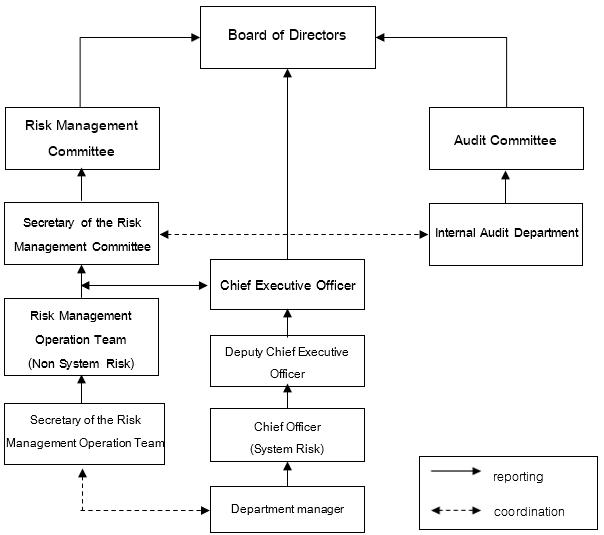
Risk Management Structure
The Company has its risk management structure as follows:
Risk Management Plans
The Company’s risk management plans are as follows:
Details | Month |
1. The Risk Management Operation Team arrangesa meeting to summarize risk management of the previous year and prepare the planfor the current year. | January - February |
2. The Risk Management Committeearranges a meeting to summarize risk management of the previous year and inspect the plan for the current year. | February |
3. The Board of Directorsacknowledges therisk management report of the previous year, as well as the risk management plan for the current year. | February |
4. Eachrelated partyimplementsthe risk management plan. | February - December |
5. ROT arranges a meeting tofllow up on the risk management progress of the organization and each department. | August |
6. RMC arranges a meeting to:
| October |
7. For each related party:
| December - January |
Risks to the Company's Business Operations
Risk Register
| Risk Name | Risk Characteristics | Consequences | Management Measures | Related Risk Factors |
|---|---|---|---|---|
| The risk from having large quantities of inventories | With more than 29 years of experience, the Company has continuously developed relationships with general retailers/distributors, offering a variety of products in terms of price and usage. This includes providing services such as problem-solving, information provision, and after-sale services to develop long-term relationships with distributors. As a result, the Company had more than 1,200 general retailers/distributors in 2025. Most of the Company’s products are sold through general retailers/distributors. In 2023 - 2025, the Company generated approximately 70%, 73%, and 76% of its revenue through sales via general retailers/distributors, respectively. | These retailers/distributors may sell products from other companies if they can provide better returns for them. | To create exclusive distribution channels and to reduce dependence on general retailers/distributors, the Company has developed Water Store shops, which are retailers that sell the Company’s water system products exclusively, and Aquatek Shop shops, which sell the premium products only under the Aquatek brand. In 2025, the Company had 20 Water Store shops and 10 Aquatek shops, both in and outside the country. The proportion of sales through Water Store and Aquatek shops combined was 24% of the Company’s total revenue. | 735 · Description: Reliance on large partners / distributors or few partners / distributors · Info category: STRATEGIC_RISK |
| The risk from brand owners entering the market | The water purifier business still has growth opportunities in the household, commercial, and industrial customer segments. Therefore, there is a risk that the brand owners will do their own marketing or that competitors will enter the market. |
| The Company is aware of this risk and has a policy of importing raw materials and products from multiple suppliers to diversify the risk that may affect the Company’s sales growth. Additionally, the Company focuses on water purifiers under its own brand rather than distributing foreign brands. Furthermore, in one water purifier system, the Company can select a variety of raw materials from multiple suppliers that are of high quality, cost-saving, and competitive to the competitors. Furthermore, because the Company conducts its business through a network of distributors in a wholesale manner, unlike other competitors in the market or some foreign competitors who primarily operate in retail sales. Therefore, the Company has a distinct advantage, along with extensive experience and long-standing relationships with customers. This includes having personnel available for after-sales services to address any issues for customers, setting the Company apart from some competitors, both domestic and foreign, who have entered the market without success due to a lack of knowledge and experience in after-sale services. Additionally, some competitors have sold products that cannot serve usage in diverse areas. | 1714 · Description: Competition risk · Info category: STRATEGIC_RISK |
| The risk from having large quantities of inventories | As part of the policy to be a comprehensive water system product supplier, it is necessary for the Company to have raw materials and products ready for sale to customers at all times. Being prepared with inventory and having lower costs than other distributors due to importing large quantities of products creates business opportunities for the Company and is a competitive advantage in its operations. Additionally, most of the Company’s products have a long lifespan, and the technology of water filtration systems does not change rapidly. The Company’s inventories at the end of 2023 - 2025, compared to the total assets, accounted for 44.33%, 39.76% and 39.52%, respectively. | Having a large quantity of inventory has an impact on a Company’s need to manage storage space, and there is a chance that the products may move slowly or become depreciated, which could affect the Company’s liquidity. | Although maintaining high levels of inventory is one of the strategies, the Company is aware of the risks involved and has prepared an analysis report on the inventory age and movement to plan for production and distribution. The age of raw materials is one of the factors the Company considers when selecting materials to manufacture water purifiers. It can be seen that the trend of inventory to asset ratio has been continuously decreasing thanks to the Company’s management. In addition, there is a plan to improve inventory management efficiency by upgrading and investing in the inventory management system to increase the efficiency of the Company's inventory management. | 1721 · Description: Inventory risk · Info category: OPERATIONAL_RISK |
| The risk of operational disruption | Currently, business operations face risks due to force majeure in many aspects. Some risks are unpredictable risks that may cause disruption to the organization's operations even if the company has managed the risks, such as natural disasters, epidemics, fires, cyber attacks, etc. |
| The Company realizes and places importance on the management of risks from operational disruptions, especially cyber risks, which will have a significant impact on the Company’s business if disruptions occur. Therefore, the Company has prepared a business continuity management plan, which will help reduce the severity of the impacts on the Company’s operations. The Company has systematically defined the structure, authority, and assignment of tasks, including testing the emergency plan and business continuity plan at least once a year to ensure that the organization’s risk management is effective and can control the risk level and impacts to an acceptable level. | 1720 · Description: System disruption risk · Info category: OPERATIONAL_RISK · 1722 · Description: Pandemic risk · Info category: OPERATIONAL_RISK |
| Liquidity Risk | The Company’s quick ratios between 2023 - 2025 are 0.49, 0.79 and 1.14, respectively, due to its reliance on short-term loan from financial institutes for purchasing goods. If the company does not receive sufficient credit lines from financial institutions to procure goods, it may encounter a liquidity crisis. | If the Company’s business is growing in the future and it cannot obtain sufficient credit line from the financial institutes for purchasing goods, it may encounter a liquidity crisis which may affect the operation of the Company’s business. | The Company is confident that it can manage this liquidity challenge and maintain its business continuity as a result. The Company’s average collection period about 25 days based on its cash sales or short-term loan provided to its customers. Meanwhile, the Company’s average payment period is 15-180 days. The cash obtained from the sales will be used for payment of the Company’s domestic debts while its debts with foreign creditors will be paid by a short-term loan obtained from a trust receipt creditor under a contract. Furthermore, the Company has obtained a fresh capital from the sale of its newly issued shares during the IPO which will be used for Aquatek and Water Store expansion and reserved cashflow. This would increase the Company’s revenues, increasing Company’s liquidity and reducing its reliance on short-term loans from financial institutes. In addition, the Company will inject its IPO’s cash into its investment in the manufacturing, assembly and modification of its warehouse to improve the management of its inventory, production time and import, thereby improving the Company’s quick ratio. | 1724 · Description: Liquidity risk · Info category: FINANCIAL_RISK |
| Risks Associated with Reliance on Loans from Financial Institutions | As of December 31, 2025, the Company mainly relies on the loans from financial institutions to purchase goods and products. The total amount of its short-term loans is 423 million baht. The Company’s total debts as of December 31, 2025 is 71.23 million baht, making its debt to equity ratio equal to 0.23 (based on total debts). Between 2023 and 2025, the Company’s financial costs are 4.37 million baht, 7.39 million baht and 2.74 million baht, respectively. The Company fixes its D/E (debt to equity ratio) at 2:1 and maintains its DSCR (debt service coverage ratio) by calculating its earnings before interest, taxes, depreciation and amortization divided by long-term liabilities due, and payable in each accounting period, including long-term and short-term loan interest of no less than 1.25. | If the sales and services are not in accordance with the plans, the reliance on the financial loans will cause financial instability and the ability to repay interest and principals to the financial institutions. This will affect the business operation of the Company significantly. | The Company has always been able to meet its financial obligations with the financial institutions. As of December 31, 2025, the financial statement of the Company shows that the Company’s D/E and DSCR is 0.23 and 0.40, meeting the Company’s requirements about the D/E and DSCR. Based on these reasons, the Company is positive that it will be able to obtain financial support from the financial institutions. In addition, the Company has not exhausted the funds from its short-term credit and its financial costs are reducing. Therefore, the Company still has the remaining funds from its existing loans from the financial institutions. | 761 · Description: Insufficient sources of funding · Info category: FINANCIAL_RISK · 1725 · Description: Income volatility · Info category: FINANCIAL_RISK |
| Exchange Rate Risk | The Company mainly orders raw materials and goods from abroad. Between 2023 and 2025, the total amount of import for raw materials and goods from foreign traders accounts for 86 percent of total purchase. These purchases are made in US dollars while the Company earns in Thai baht. This can cause an exchange rate risk. | If the US dollars are strong against the weaker Thai baht which will increase the cost of the goods and reduces the Company’s profits. | The Company has never experienced any significant exchange rate risk that can affect its performance. Between 2023 and 2025, the Company retains profits (loss) from the foreign exchange rate of 2.87 million baht, 0.94 million baht and 2.24 million baht, respectively. The Company reduces its exchange rate risk by entering into a forward contract when it needs to order goods from abroad. The Company’s executives will manage the exchange rate risk by monitoring the financial trends closely and conducting the trend analysis of the baht based on the information from the financial institutions. The Company has no policy to make a speculation on the exchange rate. | 764 · Description: Fluctuation in exchange rates, interest rates, or the inflation rate · Info category: FINANCIAL_RISK |
| Risks from climate change and the environment | At present, greenhouse gas emissions significantly impact Climate Change, serving as a primary driver for increasingly frequent and severe natural disasters. These include extreme droughts, flash floods, and air pollution—particularly PM2.5—which broadly affect ecosystems and the population's quality of life. In 2026, Thailand is projected to enter the El Nino phenomenon starting from February to March, likely transitioning into a full-scale El Nino in May 2026, which may persist until at least February 2027 (Krungthep Turakij Newspaper, February 16, 2026). | Such conditions could affect the quality of certain products, such as filter resins, which degrade faster under extreme heat and sunlight, while also impacting the well-being and health of our employees. The Company recognizes that the use of fossil fuels contributes to greenhouse gas emissions, the root cause of global warming. | The Company prioritizes greenhouse gas management by establishing a working group to collect corporate carbon footprint data and collaboratively identify ways to maximize energy efficiency. This is achieved through energy-saving measures, paper reduction, waste segregation, and investment in Solar Rooftop systems to increase the utilization of clean energy within the organization. | 749 · Description: Safety, occupational health, and working environment · Info category: OPERATIONAL_RISK · 750 · Description: Climate change and disasters · Info category: OPERATIONAL_RISK · 1717 · Description: ESG risk · Info category: STRATEGIC_RISK · 751 · Description: Impact on the environment · Info category: OPERATIONAL_RISK · 1719 · Description: Climate change and disasters · Info category: STRATEGIC_RISK |
| Labor and Personnel Risk | With the decline in the working-age population driven by Thailand’s transition into an Aging Society, which directly impacts labor availability and poses a risk to economic growth, the Company has proactively enhanced its Human Resources Management to support its long-term growth strategy. Key initiatives include organizational restructuring, strategic manpower planning, and succession planning for critical positions. Additionally, the Company organizes various activities aimed at reducing workplace stress, fostering employee well-being, and enhancing workforce capabilities through continuous training programs to support future expansion. |
| To mitigate risks associated with an aging workforce, the Company prioritizes the quality of life for older employees. This includes granting remote work privileges to eligible staff to reduce commuting fatigue and health risks. Furthermore, working hours are appropriately adjusted to allow employees more time for healthcare and restorative recreational activities, promoting a healthy work-life balance. The Company has also introduced AI technology for employees to develop essential digital skills, enabling the existing workforce to collaborate effectively with new technologies and enhance work quality. Additionally, Cloud-based systems have been implemented for systematic data storage and to strengthen Knowledge Management (KM) within the organization. | 739 · Description: Shortage or reliance on skilled workers · Info category: OPERATIONAL_RISK · 752 · Description: Impact from population structure · Info category: OPERATIONAL_RISK |
| Regulatory and legal change risk | Regulatory and legal change risk refers to the risk arising from changes in laws, regulations, or government and regulatory policies, which may adversely impact business operations, profitability, or the company’s competitive advantage. | The amendment or enforcement of new rules and regulations by relevant regulatory bodies and government agencies poses a risk of non-compliance. Any failure to fully adhere to these legal requirements could result in penalties, fines, lost business opportunities, and damage to the Company’s reputation. For instance, the introduction of new Thai Industrial Standards (TISI) for water filter products may lead to a loss of sales if the Company cannot adapt its production processes or develop new products in time to meet the updated standards. | To mitigate such risks, the legal department continuously monitors changes in relevant rules and regulations, including subscribing to updates and public relations from pertinent regulatory and government bodies. Furthermore, the Company utilizes legal advisors and audit units to provide guidance and conduct compliance checks, ensuring that all business operations fully conform to all legal requirements. | 756 · Description: Change in laws and regulations · Info category: COMPLIANCE_RISK · 758 · Description: Violations of laws and regulations · Info category: COMPLIANCE_RISK |
| Global geopolitical conflict risk | Global geopolitical conflict risk refers to the risks arising from international tensions, armed conflicts, or shifts in foreign policies, which adversely affect global economic stability and business operations. | Currently, global geopolitical conflicts, political tensions, and increasing polarization continue to intensify, hindering the certainty of economic recovery. These factors have led to heightened volatility in exchange rates and energy prices, making them more difficult to predict, which may directly impact the Company's import costs for goods and raw materials. | The Company is closely monitoring these situations to analyze potential risks and impacts. To mitigate these risks, the Company has implemented the following management strategies:
| 740 · Description: Shortage or fluctuation in pricing of raw materials or productive resources · Info category: OPERATIONAL_RISK · 764 · Description: Fluctuation in exchange rates, interest rates, or the inflation rate · Info category: FINANCIAL_RISK · 1725 · Description: Income volatility · Info category: FINANCIAL_RISK |
Risks to Securities Holders' Investment
Risk Register
| Risk Name | Risk Characteristics | Consequences | Management Measures | Related Risk Factors |
|---|---|---|---|---|
| Risk from Reliance on Major Shareholder | As of December 31, 2025, the Poovapat family is the major shareholder of the Company, accounting for 73.04 percent of all paid-up capital (held by individuals and Function Group Co., Ltd.). | The major shareholder can controls the way the resolution is passed in terms of the election of directors or other matters that need a simple majority except for the matters required by the law or the Company’s Bylaws to obtain a 3/4 of the votes e.g., capital increase, capital reduction, sale or transfer all or part of the business. Therefore, other shareholders may not potentially gather enough votes to launch investigation into what the major shareholders have proposed. | The Board of Directors has appointed more than half of the directors as independent committees, which are 6 out of 11 directors, to attend the board meeting, inspect the operation of the Board of Directors and Company’s executives, and approve necessary matters before proposing them to the shareholder meeting to ensure shareholders of transparent internal operations. | 2969 · Description: Risk of the company having a majority shareholder holding > 50% of shares · Info category: HOLDER_RISK |